Unleashing the creativity of the Church

A Christian creative ecosystem that keeps Corporate America out of Corporate Worship.

A creative community for Christian songwriters, artists, and producers. A worship song library that allows filtering by usage rights, AI involvement, and more. A nonprofit that holds those songs in trust for the body of Christ.

"We shape our systems,
and then our systems shape us."

— Robby Valderrama

The vast majority of Christian songwriters, Christian music industry professionals, and megachurch pastors are in it for the right reasons. Their motives matter — and nothing here is meant to diminish them. But intentions alone are not enough, because Corporate America is shaping the Church's worship (and theology) despite the best intentions of those involved.

Throughout history, the Church has created better systems to create a better world. May that be true in our generation.

For the biblical basis behind this framing, read the diagnostic on Christian social reform →

01 · The current system

The Shareholder-Optimized Worship Cycle.

The more Corporate America owns, the more incentive it has to keep optimizing what the Church sings around its own returns. Here's how the cycle actually works — one stage at a time.

1

Corporate America owns the infrastructure.

CCLI — the Christian Copyright Licensing International that 250,000+ churches worldwide rely on to legally sing copyrighted worship songs — is a division of SESAC Music Group. SESAC was acquired by Blackstone in 2017 — one of the world's largest private equity firms. What Christians sing on Sunday is measured, monetized, and licensed through a system whose ultimate parent is a secular investment firm.
2

Debt-based deals shape what gets written.

Christian labels — often owned by secular corporations — sign songwriters to short deals with debt-based advances. Signed songwriters are paid a lump sum upfront, but their songs must earn the money back before they see additional royalty — giving the label all the leverage. Signing means aligning with the label's commercial interests.

3

A&R shapes songs for maximum reach.

Tempo, chord progression, thematic breadth, and sonic profile are calibrated for streaming inclusion and megachurch and radio adoption. Marketing efforts focused on the churches whose CCLI reporting weights amplify royalty flow. Broadness beats specificity.

4

Pastors lead what's already resonating.

Worship pastors feel pressure to lead songs that are already resonating. It's hard to compete with the congregation down the street who's playing the songs churchgoers are already hearing on the radio and on Spotify. So they pay a "worship tax" to Corporate America to use those songs.

5

Royalties flow to shareholders.

Royalty income flows to labels, publishers, and their corporate parents. This money is used to reward shareholders and to acquire more valuable Christian music publishing catalogs. Every year, the assets are worth more. Copyrights can eventually be sold to catalog funds — Hipgnosis, Concord, Blackstone, or a peer — where the Church keeps singing the songs and the shareholders keep collecting.

6

Worship shapes theology.

Because worship shapes theology, shareholder-optimized worship produces shareholder-optimized theology. Not because any pastor chose it. Because the economic feedback loop selects for it — one Sunday, one royalty check, one A&R meeting at a time.

And the cycle continues. More owned. More optimized. More shareholder returns.

The Church should be where the best ethics and the best economics collide.

— Robby Valderrama

02 · The new system

The Christian-Owned Worship Cycle.

A parallel cycle where Christians write, a transparent library documents, and a nonprofit permanently holds — with support flowing directly to those who create. Six stages, one loop.

1

Christians and Christian-owned communities write.

Christians, Congregations, and Christian-owned communities develop songs for the Church's actual needs. Christian writers — free from indebtedness to corporations — collaborate as the Spirit leads, writing based on scripture, pastoral needs, and prophetic insight. Christian-owned writing groups such as Spring Hill Studios' Writing Club provide ongoing support for writers.

2

Songs registered on Worship Song Library.

Songs are registered on WorshipSongLibrary.com with full transparency. Who wrote it. Who owns the copyright. What corporations benefit. AI involvement (if any) via AIDcode.org. How to support the writers directly. Open for anyone to view.

3

Songs marked Free To Use.

Songs are marked Free To Use via one of two paths. The Song Stewardship Agreement is the primary path — it grants the deepest church-use protection and long-term accountability, and writers retain immediate commercial rights. Equivalent basic licenses like WorshipCommons also qualify a song as Free To Use — they grant the fundamental freedoms churches need without the additional stewardship layer.

4

Pastors discover and lead.

Worship pastors discover Free To Use songs by browsing the Worship Song Library — filtering by usage rights, AI transparency, theme, church calendar, singability, and other criteria. Without paying a "worship tax" to Corporate America.

5

Support flows directly to writers.

In WorshipSongLibrary.com, each song lists the writers, who can provide links to how people can support them directly. If they are a member of the Unleash PMA, they will receive a "Verified" badge to show they are an active part of the Christian community, not simply a songwriter collecting royalties from Christian songs. No corporate middleman. No royalty pool weighted by megachurch reporting.

6

Songs of significance held in trust.

When songs reach cultural-significance thresholds, the Song Stewardship Nonprofit takes publishing (writers still receive 80% of publishing receipts) and eventually copyright. Permanently held by the Church. Never sold to secular parties. Income funds creation of more Christian-owned songs.

And the cycle strengthens. More songs. More writers supported. More of the Church's music held by the Church.

03 · Why this is different

Other efforts exist. Here's what we do that nobody else does.

There are open-hymn projects, songwriter collectives, worship-song directories, and Christian music co-ops. Each solves part of the problem. None solves all of them at once.

ABuilt-in AI authorship disclosure.

Every song is documented via AIDcode.org before rights are ever assigned. As AI-generated music floods every catalog, the Church needs a defensible record of what is actually human-authored — and therefore actually protectable. No one else is doing this at the ownership level.

BProtection against Corporate America buying the top songs.

Once a song hits significance metrics, the nonprofit has the right to acquire copyright — permanently, at nominal cost. Copyrights held here cannot be sold to secular parties, ever. Corporate America can keep making offers; the songs stop being for sale.

CA writing ecosystem built in.

Most alternatives stop at licensing or ownership. Unleash pairs the stewardship structure with a real creative community — Spring Hill Studios' Writing Club, Production Club, and Artist Club — where the songs actually get written, produced, and distributed. 30+ new worship songs are written in Writing Club every month.

DReal accountability that people are actually Christian.

Certification runs through the independent Christian Faith & Deeds Council. Contributors and vendors are held to a Statement of Faith and a defined ethical standard. This is not self-attestation — it is independent, church-rooted evaluation, with an appeal path through the Institute for Christian Conciliation.

04 · Voices in the conversation

We are not the first to say this out loud.

Christian artists and pastors have been naming this tension publicly for years. What has been missing is the infrastructure to do something structural about it.

"When worship became commercialized and came into the industry… the ways of the world affected and changed and leaked into our Sunday mornings."

— Kim Walker

"I don't think business has any place in worship. It's hard when we bring that kind of 'return on investment' to worship music."

— Anna Golden

"I started developing this disdain for the idea of selling worship. For some reason in my heart, it felt wrong to be making a profit off something that was supposed to be a sacrifice."

— Gracie Binion

"This is the question that kept me from making Christian music for so many years — because I didn't want to make a business out of worship music."

— Forrest Frank

"What pushed me away from the Christian music industry was people writing worship songs knowing they're going to get royalties from a network of churches. I met quite a few people that had deconstructed and were still writing Christian songs and getting Christian checks."

— Cory Asbury

05 · Meet the founder

The heart behind Unleash.

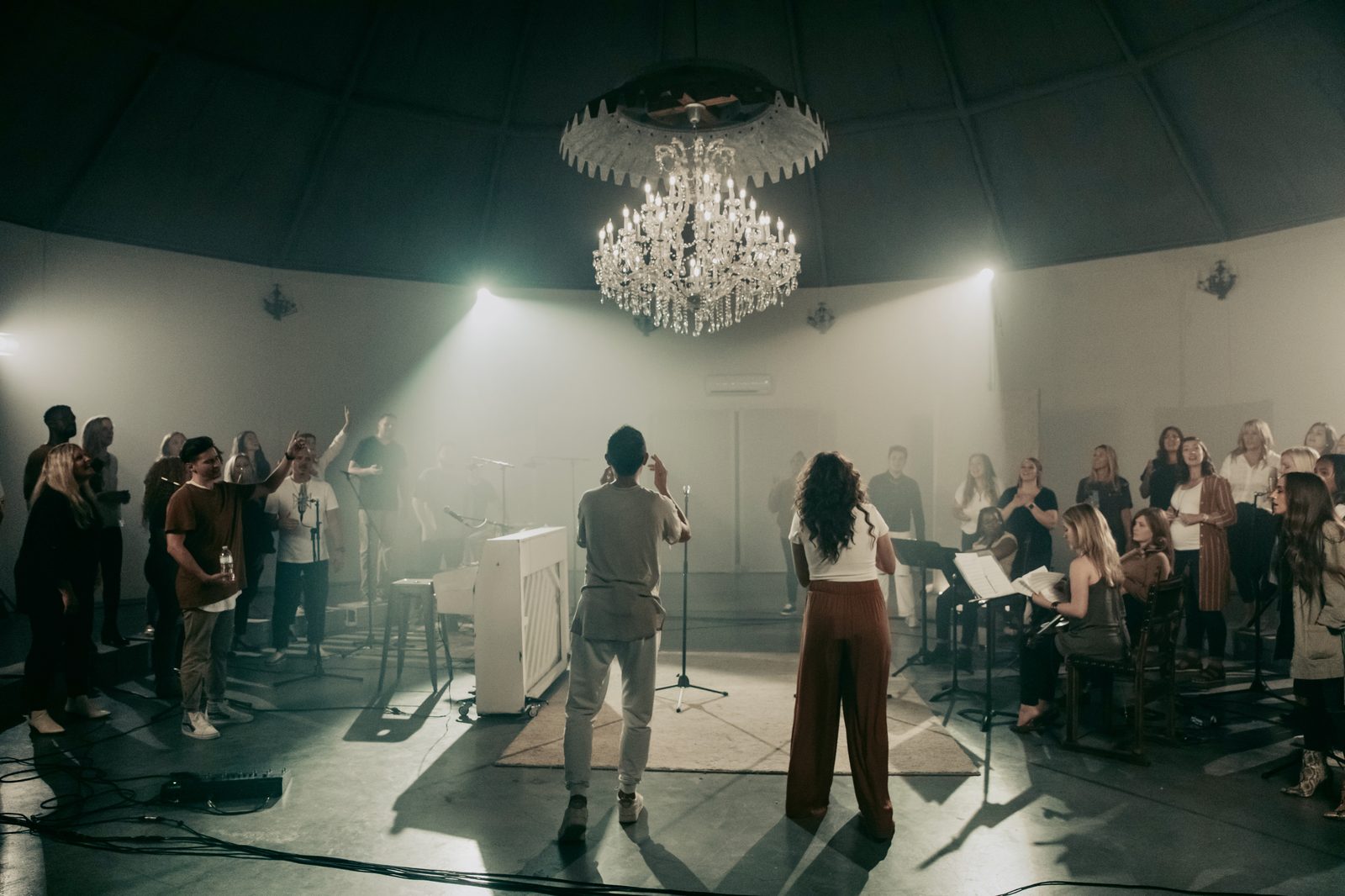
Robby and Bria Valderrama directing a choir under a chandelier

From leading worship in Silicon Valley as a teenager, to a business finance degree and a founding role at a Biblically-based investment firm, to hosting a podcast on the intersection of church, race, music, and economics, to running a Christian music agency in Nashville — Robby Valderrama's story explains why Unleash exists in the shape that it does.

He never wanted to disaffiliate from Christianity. He never wanted to concede the adjective "Christian" to those who misuse it. Unleash is what happened next.

Read the founder's story →

06 · Further study

Resources that diagnose the same problem.

People have been documenting this for years — with more depth, more research, and more historical context than any one landing page can carry. If any of what's here resonates, these are where to go next.

07 · Get involved

Want to get involved?

Unleash is a master brand over a growing ecosystem. Four sibling properties carry different parts of the work. Each is a door into the same house.

Founding donor campaign

Help build this to last.

Until now, everything you see has been “bootstrapped”. No investors or cash advances, just love for Jesus and His Church.

But getting Unleash off the ground — a Christian-owned platform, a stewardship nonprofit that can permanently hold copyrights, an independent certifying body, and the legal formation that binds them together — will take real capital to move our ecosystem out of beta.

We're raising founding donor support to make the infrastructure financially sustainable and legally watertight from day one.

Here's what founding gifts will fund:

Platform development

Building the platform, the AI agent, the Worship Song Library, and Unleash Commons. The largest line because the software is what makes the mission accessible.

Operating reserve

Twelve months of runway from the moment the nonprofit is formed. So the work continues even if year-one revenue is slower than modeled.

Legal formation

Two nonprofits, an LLC, rights agreements, bylaws, PMA structure. The paperwork that makes the mission concrete and actionable.

First-year audit

An independent audit — required to pursue ECFA (Evangelical Council for Financial Accountability) accreditation in year two.

D&O insurance

Directors and officers coverage so the board is protected before its first meeting.

Founding donors are giving, not investing. There are no shares, no governance seats, no financial returns. The gift goes to the Song Stewardship Nonprofit (or to Unleash LLC in the interim, with a commitment to transfer once 501(c)(3) status is confirmed). What donors see in return is the Church-owned worship music economy itself — built, legally protected, and durable enough to outlast the founders.

Interested in donating or connecting about this?

Message us on Instagram →

@unleashthechurch

A note on where we are

This site communicates the vision of Unleash. Some elements described here are already live; others are in beta or in active development. Everything on this page reflects real intent — but not every piece is fully built yet.

Contact the team